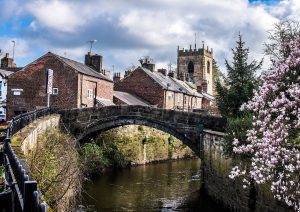
The River Nidd and the Knaresborough Viaduct together form the defining landscape of Knaresborough, shaping how the town looks, moves and feels. The river cuts deeply through the valley, while the viaduct spans it high above, creating one of the most recognisable and dramatic scenes in Yorkshire.
The River Nidd winds tightly through Knaresborough, its course carving steep wooded banks and limestone cliffs over thousands of years. Unlike broader rivers nearby, the Nidd feels intimate and enclosed here, with sharp bends that constantly change the view. Along its banks, customers can walk riverside paths that pass beneath overhanging trees, rocky outcrops and boat moorings. The river has long been central to daily life, providing water, transport and industry. In earlier centuries, mills operated along its course, and goods were moved along the valley using river crossings and narrow tracks rather than open roads.
Above the river rises the Knaresborough Viaduct, completed in 1851 as part of the railway expansion connecting York and Leeds. Built from stone and stretching across the valley in a series of tall arches, the viaduct transformed movement through the town. What had once been a slow, difficult crossing became part of a modern transport network, linking Knaresborough more directly with the wider region. Its construction was an engineering statement as much as a practical solution, deliberately elevated to clear the valley without disrupting the town below.
The relationship between river and viaduct is one of contrast. The river moves slowly and quietly, reflecting trees, cliffs and passing boats, while trains cross overhead in seconds. From below, the arches frame the sky, creating repeating patterns that draw the eye upward. From above, the view reveals the full curve of the valley, with the river threading through greenery and rooftops clustered along the slopes.
Historically, this landscape has also shaped Knaresborough’s identity as a place of defence and refuge. The cliffs above the Nidd supported Knaresborough Castle, while caves carved into the rock face below were later used as dwellings, workshops and storage. The river corridor became a place of adaptation, where natural features were reused across centuries.
Today, the River Nidd and viaduct remain central to Knaresborough’s character. Walking beside the water or standing beneath the arches, customers experience a layered landscape where medieval defence, industrial ambition and everyday leisure coexist. It is a setting that rewards time and attention, revealing how history, engineering and natural geography have become inseparable here.



 History & Heritage
 An arsenal of parkland perfection through suburbia

 Coastal


 Countryside