

Chester Town Hall
About:
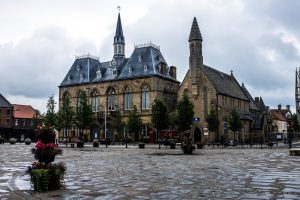
Chester Town Hall stands proudly at the centre of Chester, an unmistakable landmark defined by its rich red sandstone and intricate Victorian Gothic design. Built between 1863 and 1869, the Town Hall was designed by architect William Henry Lynn following a competition to replace the earlier Exchange building that once occupied the site. What emerged is a structure that feels both ceremonial and deeply rooted in civic pride.
From a distance, the eye is immediately drawn to the soaring clock tower, which rises high above the surrounding streets and serves as a visual anchor across the city. The tower’s elegant proportions and detailed stonework give it a sense of lightness despite its scale, while the clock face itself adds a steady, timeless presence to the busy square below.
As you move closer, the building reveals its finer details. Pointed arches, carved figures and decorative flourishes are worked carefully into the façade, rewarding a slower look. The stone has weathered gently over time, softening the building’s grandeur and helping it sit comfortably within Chester’s historic surroundings. It feels impressive, but never distant.
The Town Hall’s position within the city is just as important as its design. Set within the central square, it forms a focal point for daily life, framed by nearby landmarks such as Chester Cathedral. People gather on the steps, pass through the square, or pause to take in the view, making the building part of the city’s rhythm rather than separate from it.
Inside, the sense of Victorian ambition continues. The interior spaces are designed to reflect importance and ceremony, with high ceilings, detailed finishes and a layout suited to civic events. The building remains in active use today, hosting weddings, meetings and public functions, which keeps it connected to the present as much as the past.
 Countryside
 Major Landmarks
 Food and drink
 Family Friendly
 Heritage Railways
 Nature & Wildlife
 Coastal
 History & Heritage

 City & Culture
 Nightlife
 Sport
Sport
 Museums